Most people have heard of the wildebeest thundering across the Serengeti. Fewer know about Botswana’s own migration, the largest zebra migration in the world, and the longest land mammal migration in Africa.
Twice a year, up to 30,000 zebras travel more than 300 miles between the Okavango Delta, the Chobe River, and the salt pans of Makgadikgadi and Nxai Pan, always moving with the rains in search of fresh grazing.
What makes this migration even more extraordinary is its timing. It takes place in the rainy season, a period most travelers assume is the worst time for safari. In most destinations, the rains mean muddy roads, thick grass, and harder wildlife viewing. In Botswana, though, the opposite is true. The rains transform the Makgadikgadi and Nxai Pans into fertile grazing grounds, and this is what draws the herds south in their thousands.
Watching them arrive is unforgettable: their stripes flowing in every direction, with summer storms building on the horizon and predators never far behind. It’s a raw, fleeting spectacle, one of those rare moments in travel that feels truly unforgettable.
This is why the zebra migration is so special. While much of Africa slows down in the rains, Botswana comes alive with one of its greatest wildlife displays. For anyone visiting the country, it’s an experience not to be missed.
The zebra migration in Botswana is driven entirely by the seasons. When the rains arrive and the salt pans of the Kalahari transform into grazing grounds, thousands of zebras begin their journey south in search of fresh grasses and essential minerals. When the landscape dries again, they head north toward the Chobe River and the Okavango Delta, where permanent water sources sustain them through the dry months.
What makes Botswana unusual is that there are actually two distinct zebra migrations happening:
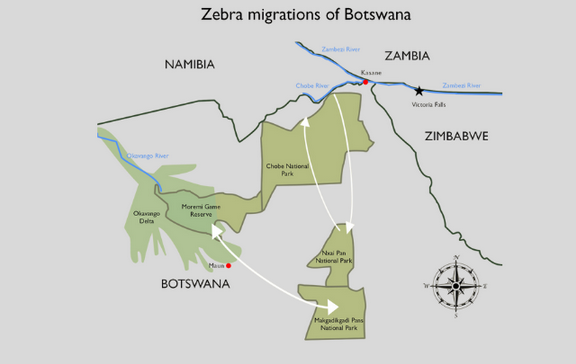
The zebra migration is all about survival. The herds move to find fresh grazing areas as the seasons change, following the rains and the growth of new grasses.
Botswana has two very distinct seasons:
If you want the most dramatic sightings, plan your safari between late December and February. This is when the Makgadikgadi and Nxai Pans are at their greenest after the rains, and the zebra herds are at their peak. Thousands gather on the open plains, predators follow closely behind, and the combination of stormy skies and endless stripes makes for unforgettable photography.
Botswana's zebra migration can technically be experienced across the country. However, much of the route passes through remote, largely inhospitable land that's difficult to access. Conveniently, the migrations start and end in two of Botswana's most spectacular national parks: Chobe National Park in the north and Makgadikgadi Pans National Park in the south.
Most travelers visit Botswana in the dry season (May–November), when game viewing is excellent in Chobe and the Okavango Delta. You'll see plenty of zebra during this time, but you won't see the dramatic mass movements, the migration only happens once the rains arrive.
That's what makes this spectacle so unique. The best time to witness the herds on the move is in the wet season (December–April), a time many travelers avoid. Yes, it can be muddy and stormy, but this is when the zebras gather in their thousands and move across the pans in breathtaking numbers.
Two areas stand out as the best places to experience the migration:
For decades, the zebra migration in Botswana went almost unnoticed. Early explorers and hunters described enormous wildlife movements across the Kalahari, even larger than the Serengeti’s famed wildebeest migration. But by the mid-20th century, colonial farming policies and veterinary fences had cut off traditional migratory routes. Populations dwindled, and many assumed that the great herds were gone forever.
Then, in the mid-2000s, researchers began to notice something unusual. Collared zebras were making puzzling movements, appearing in one part of the country one season and hundreds of miles away the next. GPS data revealed the truth: Botswana’s zebras were still migrating, quietly covering up to 1,000 km each year across some of Africa’s most remote landscapes.
What had once been thought lost was, in fact, still alive, just hidden from human eyes. Today, that rediscovery has reshaped the way we understand Botswana’s ecosystems and cemented the zebra migration as one of the continent’s most remarkable natural events.
The Makgadikgadi and Nxai Pans are some of Botswana’s most striking landscapes, wide open salt flats, endless horizons, and skies that seem to stretch forever. This is where the zebra migration unfolds, and it’s also where you can enjoy experiences that make this part of Botswana so memorable: walking with meerkats, exploring the pans by quad bike, or lying back under one of the clearest night skies in Africa.
Some of the best places to stay during the migration include:

.png?width=145&height=145&name=VECTOR_SIL%20NCR_NEWLOGO1%20(2).png)